
TMT Internal Case Study
How TMT Built AI Into Its Own Operating System
A customer signs. Sales considers the deal won. Someone still has to know exactly what was sold and route it into the right delivery process — automatically, correctly, every time.
Richard Fritzke — Founder, The Modern Trades Mentor. Trades and operations leader with more than 26 years of HVAC, facilities, and mechanical-systems experience.
Published August 16, 2026
A signed engagement isn't one thing. A fixed-scope implementation, an advisory retainer, and an ongoing growth partnership are three different operating relationships with three different delivery paths — but from the CRM's point of view, they can all look like the same event: a deal moved to "won."
Before recommending AI or automation to a contractor in St. Petersburg or Tampa, The Modern Trades Mentor applies the same principles to its own business first: understand the process, organize the information the work actually needs, define the decision points, connect the systems, and automate only the actions that should be automated. This is not a client result — it is TMT's own commercial and client-delivery workflow, shown so you can see the reasoning behind it, not just the outcome.
System: TMT's commercial and client-delivery workflow
Status: Active internal implementation — being hardened for multi-engagement idempotency
Outcome data: Not yet measured
Purpose: Show how AI and automation should be built around a real business process
Current work: the routing shown below is live. TMT is currently hardening it so a repeat engagement from the same customer gets its own delivery record — instead of being mistaken for a retry of the first one, or silently overwriting it.
What this does not prove: this is a system-design case study, not measured client ROI. No result is claimed until one has actually been measured.
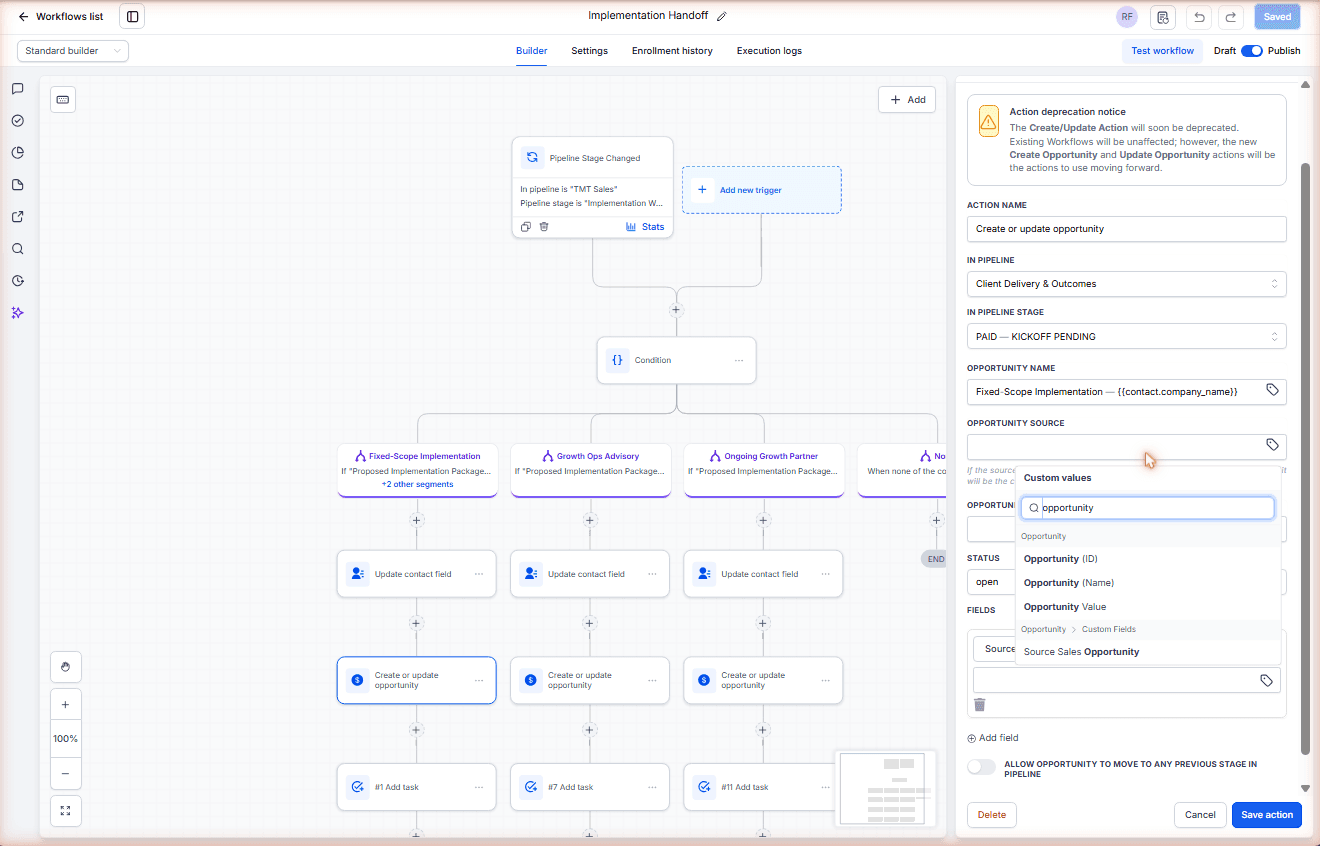
TMT's internal Implementation Handoff workflow. The system evaluates the engagement type before creating the appropriate delivery path and next actions.
This workflow begins when an implementation reaches the appropriate commercial stage. Instead of treating every engagement the same, the system evaluates what was actually sold and routes the work into the correct operating path.
A fixed-scope implementation requires a different handoff than Growth Ops Advisory. An Ongoing Growth Partner engagement requires a different operating cadence again. The automation updates the CRM, creates the appropriate delivery record, assigns accountable next actions, and preserves the commercial context behind the decision.
What goes wrong without this
Route every signed deal the same way and Advisory clients start getting implementation task lists meant for a build they never bought, while a repeat customer months later can quietly overwrite their first engagement's delivery history instead of starting a genuinely new one. Neither failure looks dramatic in the moment — they just mean the wrong people get the wrong tasks, or history disappears.
What this shows about business AI
AI agents are not magic software employees. In a real business system, they are usually a combination of instructions, business context, files and data, tools, permissions, triggers, workflows, and a model that can reason and act inside those boundaries. Files and folders matter because they can hold the operating knowledge an agent needs — SOPs, pricing rules, customer history, templates, policies, project records. But the agent also needs the workflow logic and tool access that decide when it should act, what it is allowed to do, and where the result belongs.
The agent does not replace the process. It operates inside the process.
Why the workflow matters
A weak automation says: "when this happens, do X." A stronger operating system asks a longer list of questions first:
- What actually happened?
- What type of engagement or job is this?
- What information already exists on this customer?
- What can safely happen automatically?
- What requires a person to look at it first?
- What system should own this next step?
- How do we stop duplicate work or a bad handoff?
- How do we know afterward whether it worked?
That is the difference between installing automation and designing an operating system.
What actually makes up an agent
The value of AI does not come from adding "an agent." It comes from organizing the information the agent needs and connecting it to the right systems.
- Business rules and SOPs — the judgment calls already made, written down
- Files, documents, and structured data — pricing, service history, project records
- CRM records and customer history — what already happened with this account
- Triggers and workflow conditions — what event starts the process, and what branch it takes
- Tools the system is authorized to use — what it can touch, and what it can't
- Permissions and safeguards — limits on what runs without a person checking it
- Human decision points — where judgment stays with a person on purpose
- Measurement and feedback — how anyone finds out whether it actually worked
Business first. Tools second.
TMT does not start by asking where to install AI. It starts by asking where a St. Petersburg or Tampa Bay business is losing time, where opportunities are missed, where handoffs break, where information is trapped, what decisions repeat, what work should stay human, and what system should own the truth. Only then does process change, a CRM setting, an integration, or AI actually get recommended.
AI works best when it is connected to a business process that already makes sense. If you want to understand where automation or AI could actually help your business — in Pinellas or Hillsborough County — start with a Strategy Call.
More from Inside the System
See the other real TMT systems and the business lessons behind them.