
TMT Internal Case Study
Why Leads Fall Through the Cracks — Even With a CRM
Most businesses that lose leads already own a CRM. The problem was never that the contact wasn't stored — it's that nobody could say who owned it, or what was supposed to happen next.
Richard Fritzke — Founder, The Modern Trades Mentor. Trades and operations leader with more than 26 years of HVAC, facilities, and mechanical-systems experience.
Published August 16, 2026
A customer calls, gets a quote, and never hears back. Not because anyone decided to ignore them — because the estimate sat in a pipeline with no owner, no next step, and no date attached to it, until three weeks had passed and it was too late to matter.
A CRM is not valuable because contacts live inside it. It becomes valuable when the business knows, for every real opportunity, who owns it, what happens next, and when it has to happen — and when a reply from the customer stops the automation and hands the conversation back to a person.
System: Core Reply Handoff, Next Action / Owner / Date
Status: Active internal implementation
Outcome data: Not yet measured
Purpose: Give every live opportunity an owner, a next action, and a due date
What this does not prove: this is a system-design case study, not measured client ROI. No result is claimed until one has actually been measured.
Inside the system
TMT routes inbound contact by relationship, not by a single generic funnel — a first-time cold inquiry, a warm inbound reply, an existing relationship reaching back out, and a referral each get handled differently, because a stranger and a past client don't need the same first message.
The moment a real person replies, automation stops. That's a deliberate design choice: a templated sequence continuing to run after someone has actually responded is exactly the kind of automation mistake that makes a business look like nobody's paying attention.
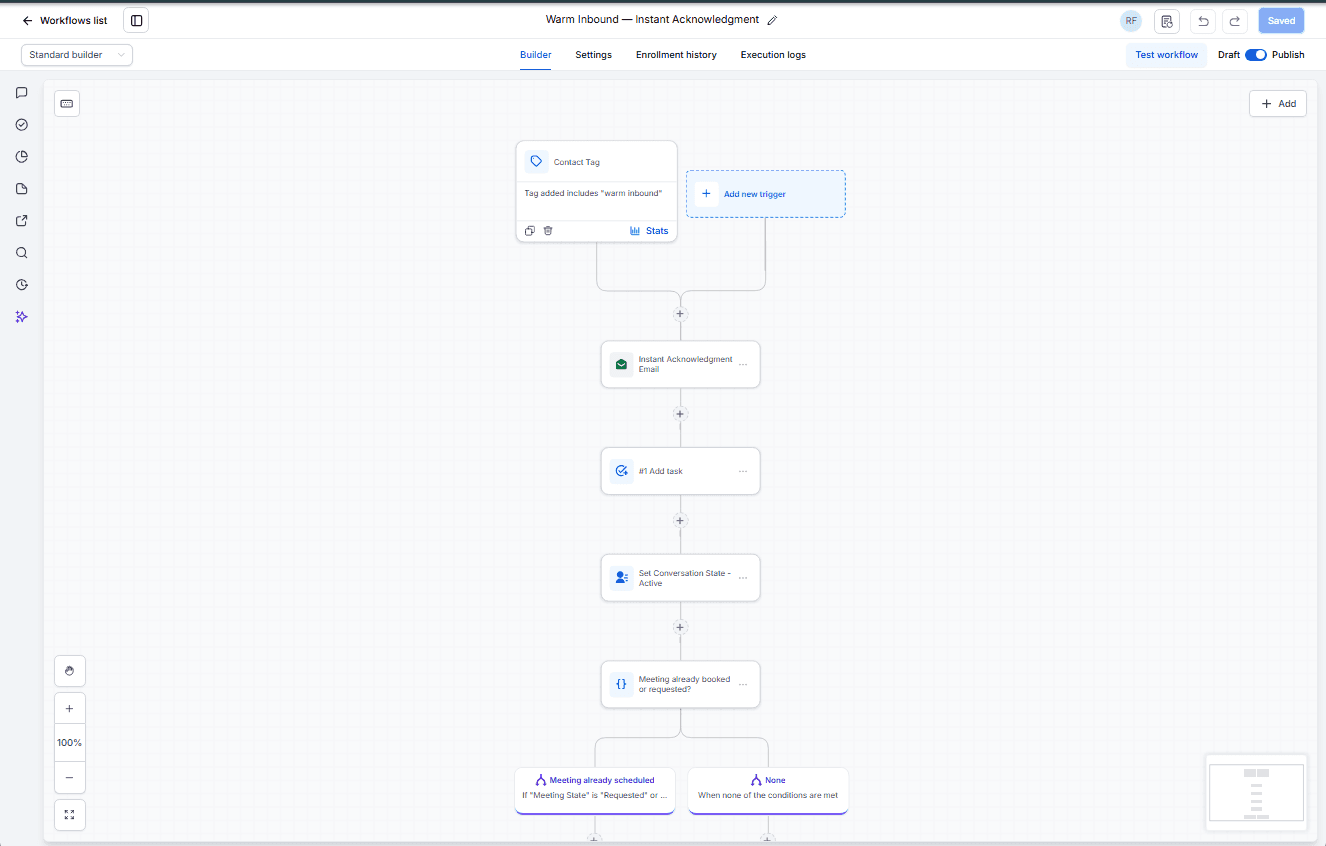
TMT's Warm Inbound workflow. A reply gets acknowledged immediately, an owner gets a task, and the conversation state changes to Active — so the opportunity has a record of ownership before anyone has to remember to check on it.
What goes wrong without this
Without an owner and a due date, a lead doesn't get lost dramatically — it just quietly stops moving. Nobody decided to drop it; it simply sat in a stage with no deadline attached until the customer had already gone with someone else. The CRM still shows the contact. It just can't show that anything was supposed to happen.
The business lesson
Storing a contact is not the same as tracking an opportunity. Automation can route the message and log the reply; it should never be trusted to decide the deal is dead or keep messaging past the point a real person answered. That judgment call — and the follow-through — has to stay with someone accountable.
What this means for your business
TMT's system requires each open opportunity to carry an answer to every one of these. Ask them about your own pipeline right now:
- Who owns this opportunity right now?
- What is the next action, in plain language?
- When is that action due?
- What commercial state is it actually in — not what stage it's labeled?
- What happens automatically if the date passes with no reply?
If you want to see whether your own follow-up has this kind of ownership and timing built in — or is quietly relying on someone remembering — start with a Strategy Call.
More from Inside the System
See the other real TMT systems and the business lessons behind them.